

The Perfect Evaluation Paragraph for 16 Markers 📝

Updated: Oct 10
Over nearly six years of tutoring AQA Psychology, I've heard every paragraph structure going — PEEL, PECL, PET, PEC- but students still consistently struggle with the same thing: developing genuine evaluation and a logical chain of reasoning.
To reach Band 4 (the top band for any essay), your evaluation needs to be "thorough and effective." But what does that actually mean in practice?
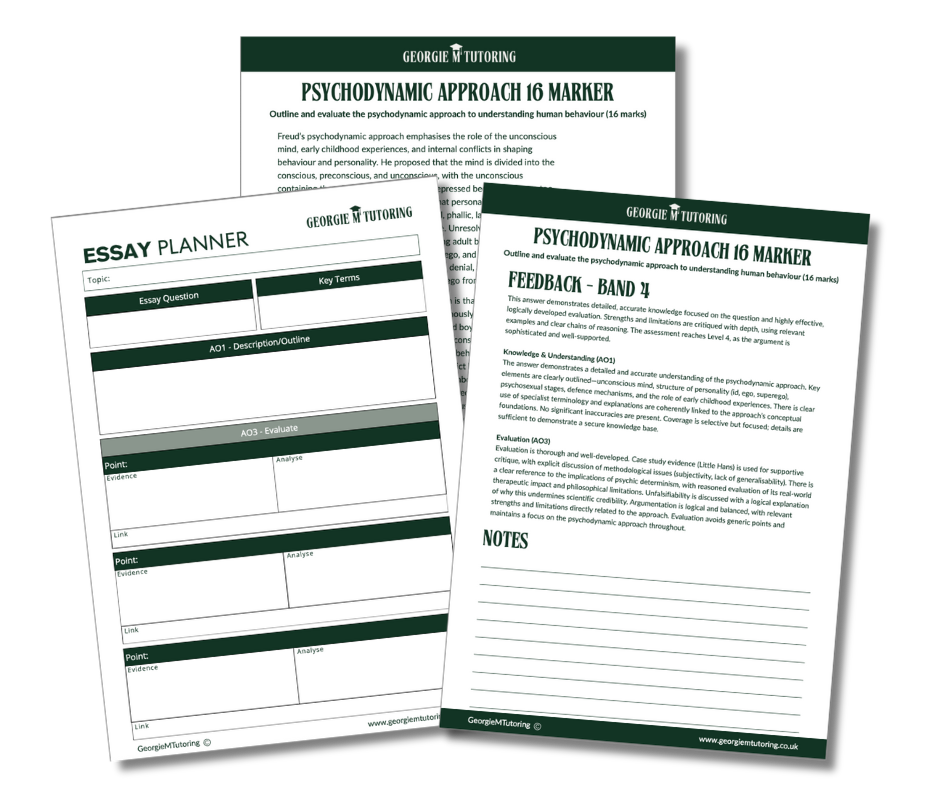
Download my FREE essay planning grid! (link below)
🎯 What Does "Thorough and Effective" Evaluation Actually Mean?
Thorough means considering your argument in depth and acknowledging alternative perspectives, rather than presenting a one-sided, clear-cut argument — because nothing in Psychology is ever that simple.
Effective means your arguments are properly supported, whether by research, key terms, or clearly described concepts. You're working to convince the examiner: here's my argument, here's why you should believe it.
🔤 What Is the PEAL Structure?
PEAL is your route to that thorough and effective evaluation Band 4 demands:
Letter | Stands for |
P | Point |
E | Evidence |
A | Analyse |
L | Link |
Let's break each one down.
📍 What Goes in the "Point"?
Your Point is a clear, signposted evaluative statement. Keep it short, and make sure it's obvious you're evaluating — starting with "One strength…" or "One limitation…" is fine (you won't lose marks for repeating the same sentence starters; keep it simple).
Make sure key terms appear here too, so you're showing the examiner exactly what you know. By the end of this sentence, the examiner should know whether you're discussing a strength or a weakness, and what it's about.
🔍 What Goes in the "Evidence"?
If you're evaluating research, include key procedural details and findings to support your argument. For Issues & Debates evaluation, outline the issue or debate and link it directly to the theory or research in the question.
This often starts with "For example…" or "Research conducted by…"
🧠 What Goes in the "Analysis"?
This is where you explain what your evidence means, and why it's a strength or a weakness: "This is a strength/limitation because…"
This part should feel fairly obvious to you, because you already know the argument you're making. But the examiner might not — so spell it out.
Then, and this is how you get the A* you're after: analyse the implications or limitations further with a "however" or "furthermore" point. This should link to what you've already said — it's an elaboration, not a brand-new point.
🔗 What Goes in the "Link"?
Think of this as your paragraph's conclusion. Summarise your argument, then bring it back to the question to complete the evaluation.
Don't introduce anything new here. Make a clear statement of where you land on the argument, based on what you've already provided. It has to follow logically from what you've said, if you've only highlighted limitations and given no positives, you can't suddenly conclude the theory has value. This is a summary of the argument you've already made, not a plot twist.
🔥 Tutor Tip: Three of these paragraphs is plenty to achieve the Band 4 response you're aiming for. You don't need five evaluation points crammed in, you need three that are genuinely thorough and effective.
📄 See PEAL in Action: A Full Example
Here's a complete PEAL evaluation paragraph, exactly as I'd want a student to write it:
(P) One strength of the psychodynamic approach is that it's supported by research evidence from case studies. (E) Freud (1909) investigated a five-year-old boy, Little Hans, who had developed a phobia of horses. Freud regularly consulted with Hans's father, who reported Hans's dreams, fears and behaviours. Freud interpreted these as signs of unconscious conflict linked to the Oedipus complex, suggesting Hans's fear of horses symbolised repressed anxiety towards his father. Once this conflict was resolved, Hans's phobia disappeared, providing evidence that unconscious processes can influence behaviour. (A) This is a strength because it supports the psychodynamic approach as it shows how unconscious conflicts, which we can't directly observe, can produce real behavioural symptoms, and resolving these conflicts can reduce distress. That makes Freud's work an important contribution to understanding mental health. However, Little Hans was a single case study, and Freud's interpretation was highly subjective. Because he relied on second-hand reports from the boy's father, the evidence lacks reliability and objectivity. Other psychologists might interpret the same behaviour very differently, meaning the conclusions aren't easily generalisable. (L) Therefore, although Freud's case study supports the idea that behaviour is influenced by unconscious conflicts, the unscientific and subjective nature of the evidence means the psychodynamic approach lacks reliability compared to more empirical approaches such as the behaviourist or biological perspectives.
Download My Essay Planning Grids (Free)!

👋 About the Tutor
I'm a full-time independent tutor with over five years of experience helping students master AQA A-Level Psychology. With a Master's in Political Psychology (Merit) and a BSc in Criminology (First), I move students beyond the "overwhelmed" phase by focusing on high-level subject mastery and flawless exam technique. I am Enhanced DBS-checked and safeguarding trained.
How to Work With Me
👥 Study Club: A supportive weekly space to revise key A-Level Psychology topics together. We break down tricky content, practise exam questions, and build confidence.
🚀 Masterclasses: Intensive courses designed for the crucial build-up to exams. These sessions focus on the topics students find most challenging, helping you consolidate knowledge, strengthen evaluation skills, and feel more prepared walking into the exam.
📚 1:1 Tutoring: Personalised support tailored to your exact needs. These sessions focus on strengthening understanding, building exam technique, and boosting confidence so that learning starts to feel manageable again.


Comments